On Christopher Hitchens

Christopher Hitchens succumbed to cancer on December 15th.  Hitchens was a prolific writer and polemical pugilist who angered many and wooed more.  He possessed an acerbic  wit and a taste for battle.  Unfortunately, toward the end of his life, these hallmarks faded into a robotic defense of such luminaries as Paul Wolfowitz and noble actions as the wars in Iraq and Afghanistan.  Still, when he reviewed literature he was usually on point.  That is why it was such a pain to read his political commentaries in later years.  As Alexander Cockburn pointed out, Hitchens always had some opportunism about him, and he also wrote in favor of some horrific things while he was “on the left.”  For example, his glorification of the Genocide of the Native Americans as having been done with “vim and gusto” comes to mind.  (See Churchill, A Little Matter of Genocide).

In today’s blog, I am going to turn back the clock and share an analysis that I wrote of an article that Hitchens published in Slate Magazine on the topic of Iraqi civilian casualties.  It follows:


Who is the Real Moral Idiot?

Christopher Hitchens’ latest ink-letting in Slate Magazine entitled “The Lancet’s Slant: Epidemiology meets moral idiocy” is as dishonest and vile as they come.  In it, he lambasted an anti-war movement of his imagination and a respected medical journal for daring to publish the harsh realities of Hitchens’ favorite war.


Epidemiological studies of war-torn countries are common these days.  In fact, the Lancet has published such studies on Darfur, Sudan, which is widely cited by both critics and opponents of the Iraq War, including none other than Hitchens himself.  In 2005, Hitchens expounded on the situation in Darfur and referred to estimates of 400,000 dead in Darfur as ‘reliable.’  While he did not cite any specific research, there are two groups which published those findings, and one of those was the Lancet.


While knowing little about epidemiology, it appears that the Iraq study is born of the same methodology and is judged as sound by those who are in the know.  For example, Richard Garfield, a professor of Public Health at Columbia University told the Christian Science Monitor “There is no discrediting of this methodology. I don’t think there’s anyone who’s been involved in mortality research who thinks there’s a better way to do it in unsecured areas. I have never heard of any argument in this field that says there’s a better way to do it.” (Dan Murphy, ‘Iraq casualty figures open up new battleground,’ Christian Science Monitor, October 13, 2006)”  What then is the motivation for Hitchens’ latest screed?  Judging from the snide tone and haughty nature of it, it is not just a political one but a personal one.


Hitchens begins his protest by asserting that the figures in the Lancet study are both precise and imprecise.  He takes issue with what the authors deem as the cause of deaths, which are attributed to “the war”.  In the same breath, Hitchens raises reports that a letter to the Lancet published in 1995 was guilty the same imprecision in citing the deaths of 567,000 children as a result of ‘the sanctions’.  This is interesting considering that Hitchens often cited the deleterious effects of sanctions as a rationale for the war in Iraq even to the point of mentioning that as many as a half of Iraqi children had died because of them.  Also curious is that he does not challenge the validity of the number but merely says that it is slightly subjective.  Mind you, this estimate is similar to a UNICEF study published in 1999 claiming that the number of children who perished as a consequence of sanctions was at 500,000.  So it is not the number Hitchens challenges but the conclusion as to who is responsible.  However, this should not prevent us from discerning the reason he mentions the two together, namely, to score pot shots at his opponents in the anti-war movement.


Indeed, Hitchens uses the figure of dead Iraqi children not to raise concern but to smear opponents of the war.  He writes “We haven’t heard so much about the massacre of the innocents by sanctions of late, because the sanctions were lifted since the overthrow of Saddam Hussein. But even before the invasion, the subject largely disappeared when “anti-war” forces suddenly decided that sanctions were permissible after all because they were helping to keep Saddam “in his box.”  This is true only in the misleading sense that we would have to discount the majority of the anti-war movement.  One doesn’t have to look very hard to find that there were a number of groups such as Voices in the Wilderness, who opposed both the sanctions and war against Iraq.  This is truly a display of one of the hallmarks of the Stalinists whom Orwell skillfully exposed during the Spanish Civil War.


Carrying on in this fashion, Hitchens then grants the studies conclusion as true-for the sake of argument- only to go further in justifying what he deems the postponed liberation of Iraq.  It is worth noting in this context that this moral idiot can waste column inches lampooning the authors of a serious study while simultaneously remaining silent about the morally frivolous comments of the President of the United States who when asked about Iraqi casualties a year ago insouciantly replied, “30,000-more or less”.  That a so-called humanitarian should spend more time berating anti-war activists and those that raise the serious concern of the harmful effects this war is having on the people of Iraqis nothing short of wickedness and depravity.  It recalls the words of Randolph Bourne who condemned John Dewey during World War I as a “A philosopher who senses so little the sinister forces of war, who is so much more concerned over the excesses of the pacifists than over the excesses of military policy, who can feel only amusement at the idea that any one should try to conscript thought, who assumes that the wartechnique can be used without trailing along with it the mob-fanaticisms, the injustices and hatreds, that are organically bound up with it, is speaking to another element of the younger intelligentsia than that to which I belong.”


Hitchens goes on complain of the reference to 45% of Iraqi deaths being attributed to ‘unknown’ causes and that 24% were caused by ‘other factors’.  He states that since the study only attributes 24% of deaths to the coalition and does not distinguish between ‘unknown’ and ‘other’ causes of death that this is an example of moral idiocy.  However, the study doesn’t do what Hitchens says it does.  When the Lancet study attributes deaths to other causes it states they can be attributed to non-coalition forces, while ‘unknown’ causes refers to a case where they cannot confirm whether the deaths were caused by the coalition or not.


Not to be outdone, Hitchens invites us to join him in making light of dying Iraqis by asking us to assume that some percentage of those the United States is killing were mass murderers anyway.  While it is of course true that some of those the US is killing are those whom Hitchens describes, this is just grasping at straws.  It is the same argument trotted out by Likudnik’s to justifySharon’s collective punishment procedures in the West Bank and Gaza.  And we all know what Hitchens thinks of that odious man.

Furthermore, to argue that despite the carnage the price is worth it because along the way the US got rid of some despicable men is to fall victim to a moral collapse.  This is the argument that the ends justify the means.  It is also the reasoning of every terrorist, whether in a cave or in Washington.  So we must ponder upon reading this latest diatribe: who is the real moral idiot?


Posted in Uncategorized | Tagged , , , , , | Leave a comment

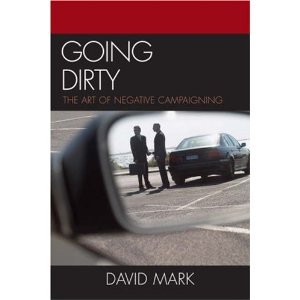
The Art of Negative Campaigning: A Book Review

With Newt Gingrich going around the country abusing the most vulnerable, I thought I’d take the time to share a book review on Negative Campaigning.

Those who study politics are constantly subjected to the idea that no one likes negative campaigning. Yet, for some reason it is so pervasive. It is for this reason David Mark’s Going Dirty: The Art of Negative Campaigning is a dreaded but necessary read. Mark shows, in this detailed account, not only that negative campaigning is an integral part of elections but that it is incredibly successful. In addition to being told that negative campaigning is reviled, we also hear the constant refrain that politicians need to campaign on positive messages like in the good old days. However, as Mark shows, there were no good old days. In fact, negative campaigning in American politics is as old as American politics itself. This book is an excellent survey of the evolution of negative campaigning in the United States that takes the reader through a myriad of examples ranging from the gross tactics of Jesse Helms up to the days of his successor Karl Rove. With a resounding message: negative campaigning is here to stay, it is a grotesque yet fascinating story of the poisonous politics of pestilence.

The most edifying story of this saga is the one of Senator Jesse Helms. Helms made a career out of negative campaigning, particularly in the arenas of race baiting and anti-communist rhetoric. His strategies included the Nixonian tactic of innuendo to outright attacks on his opponents. Helms got his start in the viciously racist campaign of Willis Smith, who used white voters’ fears of racial integration in a most disgusting manner. Helms continued this race baiting with his outspoken opposition to making Martin Luther King Jr.’s birthday a national holiday. This does not exhaust Helms’ shadiness. Most striking to me in this regard was his connection the Congressional Club, a Republican fundraising outfit and attack machine. This group was instrumental in helping Helms maintain his Senate seat. Unique about this relationship was that this group did not see any way fit to campaign for Helms except by going negative. Certainly there are few politicians who are in this category but it is unsurprising that Helms was one of them. After all, this was a man who had ties to Latin American death squads and other notorious individuals. To be sure, Jesse Helms’ method of attack left a legacy that later became the model from which Karl Rove based his smear against John McCain that he fathered an illegitimate child.
Negative advertising isn’t always effective. Green’s hard-hitting chapter on the limitations of negative campaigning aptly describes the tactic as a double-edged sword. Green’s position is not without substantiation, either. Indeed, there is a plethora of examples of negative tactics gone awry. Sometimes it is simply that the issue being exploited is outdated, as in the case of Lisa Quigley’s attack on her opponent Jim Costa. Other times the claims within the advertisement are not credible, causing them to backfire. By far the most powerful attack that foiled was Senator Kerry’s comment about Vice President Cheney’s daughter’s sexual orientation. This is a perfect example of an attack that went below the belt, causing many people to empathize with the Vice President about his family life and the lack of respect that Kerry showed for his privacy.
With these examples it is clear that Mark presents a nuanced account of negative campaigning, showing where it works and where it doesn’t. One of the trends he captures in this regard is the attack book. Although it remains to be seen how far this medium will go, we are already seeing it evolve this campaign season with a book called The Obama Nation by Jerome Corsi, who also authored an attack book on Senator Kerry called Unfit for Command. These books have been exposed as having numerous factual errors and distortions. The question arises after reading these tracts is whether this method of attack is a new low in American politics? Also, will there be more books of this sort? This is relevant to ask because in spite of their veracity being challenged, these books generate a lot of controversy.

Although it is difficult for me to admit, I did find this book to be well worth reading in spite of its somber message. While I embrace the politics of positivity, it is always important to remember what is actually going on in the world around you. It is for this reason that I recommend this book to anyone looking to study this ghastly art.

Posted in Uncategorized | Tagged , , , , , , , , , | Leave a comment

Hard Times at Occupy Boston | The Nation

Hard Times at Occupy Boston | The Nation.

Posted in Uncategorized | Leave a comment

How Are We To Live? A Discourse on Ethics

In an age dominated by greed and the pursuit of narrow self-interest, Peter Singer asks the question, “How are we to live?” Ultimately, we ought to live ethically, but what does that mean? To answer these questions, Singer draws on ancient to modern philosophy and explores the possibility of living an ethical life. Through the use of
numerous case studies he examines the current dynamics in Western Civilization in order to derive general tendencies of the populations that inhabit them. Singer avers that it is an urgent matter to heed the call to live an ethical life, help end suffering in the world, and usher in a better tomorrow.
Singer’s discussion of whether an ethical life is possible is convincing and is the strongest aspect of the book. It allows him to lead to the discussion on what course of action is necessary to live such a life. He uses numerous examples drawing from the fields of history, philosophy, and evolutionary biology for a well rounded approach to these questions. I found particularly illuminating his discussion of how a stronger wolf will not kill a weaker one after it concedes defeat in battle. Singer quite correctly asks why this is so and speculates that there is a higher purpose being served, such as survival of the species. Moreover, his generic example of the nuclear family is another he uses to tackle the question of whether human beings are capable of living ethically. He shows that the selflessness exhibited by parents toward their children points toward an affirmation of his thesis.

The use of the Japanese business model as a counterexample to the American one serves to show a stark difference in the way human beings organize themselves in collective bodies. This is the weakest part of Singer’s argument. He conveys the impression that the Japanese have found the answer to how businesses should operate. In fairness, I partially agree with this premise. The distribution of pay and the treatment of workers like family members is something the American business model could use. Although Singer does raise the possibility that the Japanese system has flaws, especially discussing the long work hours coupled with the stress that comes with it, he stops short of questioning whether this way of life could conflict with his suggestion that we lead an ethical one. After all, if one works from 8 AM until 10 PM there is very little time left to live up to the noble callings of developing the welfare of all people. Moreover, one must question the underlying premise of the economic system, namely Capitalism, that Japan upholds and see whether it is contributing to, rather than alleviating, one of Singer’s central concerns: the rapacious destruction of the environment. Nonetheless, his use of the Japanese system sheds light on the possibility of human beings organizing themselves around the values of solidarity and concern for others.

Another weakness of the book is that the author fails to address other possible modes of living. I found myself asking, is life really a choice between some vague conception of an ethical life or a pursuit of wealth and power? Singer’s arguments would be much stronger if they addressed that which seems to be an obvious fact of life. Most people not only do not think of their lives in such a constricted manner but live a life consumed by the constant struggle to fulfill basic needs. It is this reality which prevents people from even pursuing the kinds of questions Singer is raising. For example, even in the economically developed countries, affordable housing and access to health care has become a growing problem to the point where the leading cause of bankruptcy is an inability to pay medical bills. This also leads one to believe that Singer’s audience is not the ordinary factory or office worker but those of the professional class. To add to this impression, his case studies of humans seem hyper-focused on the super rich and the very poor. Conspicuously absent from Singer’s account of Western society are the middle and working classes.

How Are We To Live? is a highly readable text that is a simple but nuanced attempt to rekindle the ethical questions philosophers have asked throughout the ages. Although it offers no coherent blueprint for how we should live, the book offers a passionate reasoning of how we should not. Though I felt that Singer was flippant in moments and that his arguments for what course of action to undertake were short on substance, even direction, his contribution is significant to the field of ethics and social and political philosophy. It is high time that we abandon the pursuit of yachts and fancy cars and devote some time each day to “helping thy fellow neighbor.”

Posted in Uncategorized | Tagged , , , , , , , , | Leave a comment

Occupy Wall Street and ‘White Privilege’: A Personal Perspective

 The issue of racial minorities and the Occupy Wall Street movement has been making big news recently.  For example, the Boston Metro reported last week that some in the Occupy The Hood movement have been breaking ties with Occupy Boston.  One of the reasons for this is because Occupy Boston is redolent of white privilege.  Later that week, an article in the Washington Post discussing the very same issue put the question eloquently.  It reads: African-Americans share white Americans’ anger about corporate greed and corruption, and blacks have a rich history of protesting injustice in United States. So why aren’t they Occupying? This is a question I have asked myself and my friends, the majority of whom are immigrants from Africa and Asia, but also are African-American, Hispanic, Native American, Russian, and so on.  I have been given various answers, all of them interesting.  One of the most interesting responses came from a great friend of mine from Bangladesh.  He told me pointedly that “I understand why you are standing up for your rights.  You grew up here and have something to lose.  Where I come from we don’t have such high expectations and not much to lose.”  I pressed him further asking whether he feels like he has much to lose now.  He says that he does but with 2 kids, a wife, and a full-time job, he can’t give too much to such a movement.  Fair enough, I thought.  So it seems from the Post article and the responses from my friends that there are a range of reasons why African-Americans, Native Americans, and ethnic minorities in the US are not showing up in larger numbers.  What I hope to address in this blog is the issue of ‘white privilege.’

I want to share up front that this post is more personal reflection than analysis.  It comes from my own perspective and is colored by my experience.  When I visited Occupy Boston one of the things I noticed was that an overwhelming majority of people there were white.  In fact, this is something that I asked amid anti-war demonstrations throughout the previous decade.  Perhaps the reason was then and is still because African-Americans, minorities, and poor whites are too beaten down by the system to join up.  But it always lingered in my thoughts that maybe there is another reason.  Might it be because of ‘white privilege’?  Just what does that term mean and how much does it hinder a movement?

Practicing ‘White privilege’ refers to the act of suppressing minority groups for the advantage of the majority.  This can be done knowingly or not and more often than not it is subtle and not overt.  It takes the dominant group’s situation as the norm and attempts to impose it on the rest.  In addition, it places the onus on the minority group to reach what the majority regard as the norm.  As such, the practice of ‘white privilege’ sets up an unreachable goal for minorities because it is one that is continuously defined by the dominant group.

The criticism of Occupy Wall Street has been that it is a movement started by whites and as such will represent the view of whites.  I’m sure most whites involved would argue that this is untrue.  However right they are in their reply, they are also wrong because in a deeper sense, it is true.  After all, police brutality and home foreclosures have been going on since before 2011 and yet there was no Occupy movement.  Is the concern over this growing merely because now it is hitting white middle class Americans?  African- Americans have been dealing with these issues for years and I can understand their apprehension toward joining a movement which is late to the party and dominated by whites.  To address my own personal record on these matters, my friend and I were arguing for an occupy type of protest to take place back in 2001 when bombs first started dropping in Afghanistan.  But I digress.  I don’t recall many demonstrating  in Boston over the execution of Troy Davis (apart from the usual crowd) and that was this year!  Even more obscure, how many were there for local Palestinian activist Amer Jubran?  I don’t recall very many showing up to hearings, marching outside government center.

I wrote a post on Occupy The Hood last month in which I wrote that we whites need to stop preaching and start listening to African-Americans and other minority groups before we can make real changes.  The fact is that we won’t be taken seriously until we take everybody else seriously.  We whites need to look at ourselves and see the interconnectedness of our struggles with the rest of the people around us.  We need to address the subtle nuances of our concerns and be understanding of our biases.  We need to, as the great historian, Ronald Takaki suggests, hold America and ourselves up to “A Different Mirror.”  We have come to a crucial moment that cannot and should not be squandered.  It is essential to doing away with ‘white privilege’ and more importantly, toward breaking the cycle of cultural misunderstanding.

In spite of this, I want to stress that no movement should be shunned because some of its members are late-comers.  This is a lazy criticism that stifles energy that could be harnessed to address real problems.  I am not arguing here for the immediate joining of such movements but of critical engagement with them.  There may be white privilege on display and a lack of understanding but the existence of such tendencies should be seen as an opportunity for dialogue and teaching, not of outright dismissal.  These are well-meaning individuals, not crooked Wall Street brokers or opportunistic politicians.  They are also mostly young and were just children during the last decade.  Should these people be faulted for not marching against the war in Iraq because they were 12 when it began?  Should I be faulted for not protesting police brutality after 41 shots killed Amadou Diallo (I was 16 then and just cutting my political teeth)?  I welcome anyone who is “late to the party” and want to engage with them.  The beauty of social movements lies in their description.  Human beings are social animals with a unique ability to communicate with one another.  Lets embrace this in order to learn, teach, and struggle together in order to build a better world.

We should be grateful that this discussion is being had.  As such, I welcome all comments and feedback and look forward to an open dialog.

Posted in Uncategorized | Tagged , , , , , | 4 Comments

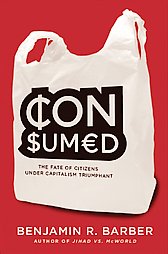
A Black Friday Special: Consumed by Benjamin Barber

In the 1930s and 1940s, the United States was in crisis. A Great Depression afflicted the nation and millions suffered in poverty. Real needs were not met in the market. Today, the United States is in crisis again. However, it is a different kind, one that ultimately affects our civic institutions and democracy. In Consumed, Benjamin Barber examines this state of affairs and makes a compelling argument that the rise in consumerist capitalism has stunted social growth and is leading down a path toward an unstable and unsustainable future.
In today’s America, companies no longer face the prospect of being unable to meet production needs. As Barber makes abundantly clear, theirs is a crisis of overproduction. This makes for the necessity to manufacture markets where they ordinarily wouldn’t exist. One of the ways this is achieved is through a technique in advertising called branding. Such branding, Barber argues, has contributed to a lifestyle whereby individuals selfishly cling to material goods without considering the consequences of compulsive consumerism. He goes on to argue that this mode of thinking stands in stark contrast to the mode of living of past generations. In its earlier days, the engine of capitalism was fueled by what Max Weber termed The Protestant Ethos. This way of life is centered on hard work, long term thinking, and investment. Today this system has been replaced by what Barber calls the Infantilist Ethos, a regiment which aims at keeping adults and children perpetually youthful. This is useful because it keeps them chasing after created desires, like iPods and brand name clothing. Such an ethos now drives our economy.
The most troubling aspect of this ethos is how it affects our civic culture. If people are pursuing created wants in a consumerist economy masquerading itself as the very essence of freedom, how can people engage meaningfully in their society and contribute to the growth of democracy? As we have seen, the very same marketing techniques used by Coke and Pepsi have been employed by political campaigns. Politicians are packaged and branded for consumption by the American public. But as with most products, do we really know what we are getting? In a democracy the duty of citizens is to make informed choices in electing their leaders but this is becoming increasingly difficult amidst the omnipresence of advertisements showing the package and not the substance. It is not so much that obtaining the information is impossible but that it is “drowned in a sea of irrelevance,” to quote the late social critic Neil Postman. The result is a grave threat to the level of discourse in this country which ultimately could lead to the deterioration of our precious institutions and our democracy.

 
Fortunately, there are ways to challenge this trajectory, and Barber discusses a good many of them in the book. For example, the segment devoted to culture jamming makes the point effectively. This refers to a technique whereby the meaning of the symbols corporations use to lull us into a consumerist sleep are hijacked and neutralized. A great example of this is a spoof of a Calvin Klein ad by Adbusters, which features a hairy chested male and the text reads “Reality.” This is not without danger, for these techniques can be co-opted by the nefarious forces that Barber rightfully identifies. Barber concludes that we as citizens have to revamp capitalism and get it to address real needs, not manufactured ones. He lauds the concept of micro-credit practiced by Muhammad Yunus of the Grameen Bank. This is a means of getting the poor to pull themselves out of the swamps of misery and poverty and develop the self-sufficiency that is embodied within the Protestant Ethos.
If you want to find out how American culture developed into itself, read this book. It raises many important issues and poses possible solutions. Although seemingly not as urgent as the Great Depression, the consumerist culture we inhabit may unravel our democracy. Barber’s words may someday be considered prophetic if we don’t heed his call.

Posted in Uncategorized | Tagged , , , , , , , | Leave a comment

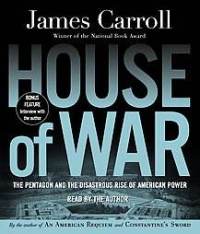
How the United States Became an Empire: A Review of James Carroll’s House of War

Has the rise of American power been disastrous?  James Carroll asks this pointed question in House of War, a brilliant history of the Pentagon interwoven with a personal narrative.  Carroll is an apt person to tell this story.  The son of a general who became a priest, Carroll spent a fair amount of his childhood in that five-sided building, growing up only to try to exorcize the demons from it in that famous anti-war demonstration in 1967.  This book not only captures a compelling personal story but details how the United States maintained its hegemony over a period of 60 years.

Carroll’s ability to use individuals’ personalities within the Pentagon establishment to raise questions about the ‘what ifs’ of history is the most powerful element of this book.  Given that much of the story is centered on living in the nuclear age, the most captivating story in the book involves the debate over giving nuclear weapons to the Soviet Union.  The main proponent of this was Henry Stimson and his nemesis, secretary of Naval forces, James Forrestal.  This raises an interesting question: would giving the Soviet Union the secrets to the atomic bomb have co-opted them into the world system and ended the hostilities between the US and USSR?  Carroll reveals a just paranoia on the Soviet side.  Russia had just been invaded by Germany, a country with which it had a pact.  Stalin himself was concerned with Western encroachment into his territory.  Would following Stimson’s advice have meant an end to this tension?  A closer look at history reveals that the Soviet Union was actively seeking to accommodate the United States.  It undermined the independence movement in Greece, arresting members of the EAM (the Greek Guerilla movement) when it sent a delegation to Moscow.  Moreover, the Soviets also offered to get out of East Germany on the condition that the country could have internationally supervised elections and would not be a member of NATO.  Nonetheless, I’m not sure, given the tone and determination of Paul Nitze’s famous NSC-68, that the United States would have abandoned its messianic vision toward global hegemony which would have ultimately pushed a nuclear armed Soviet Union into some form of confrontation.  In essence, the problem United States policymakers had wasn’t solely with a well armed Soviet Union but with the Soviet Union as a representation of a competing global power.

Indeed, the Cold War was not the Manichean world that our leaders had us believing.  It was filled with infinite shades of grey and almost always involved poor Third World countries being caught in the cross fire.  Carroll’s account of the Vietnam War is an example of the author demonstrating his finest work.  By tracking his moral quandary over his father’s involvement in the military, him loving the Pentagon as a child, to being swooned into finally protesting it by the Jesuit priest, Father Phil Barrigan, Carroll demonstrates a remarkable ability to be analytical, passionate, and searching at the same time.  Carroll’s description of the Vietnam War as a battle of technology against poor peasants aiming only for their own independence is told with the passion and compassion of a man deeply concerned with the fate of humanity.

Skipping to the section covering the end of the Cold War, Carroll is most cogent.  His description of the actions of NATO in Kosovo and how the American government ignored the peace movement in the former Yugoslavia is telling.  It can be seen as a foreshadowing of what was to come years later in the confrontation with Iraq: a power bent on doing whatever it wanted in the world without asking permission from anyone.  Carroll rightfully identifies this and eloquently calls on the reader to stop this madness.   House of War makes for an informative and provocative read on the dark side of American foreign policy.  Indeed, it is a powerful anti-war epic that should be an instant classic.


Posted in Uncategorized | Tagged , , , , , , , | Leave a comment